

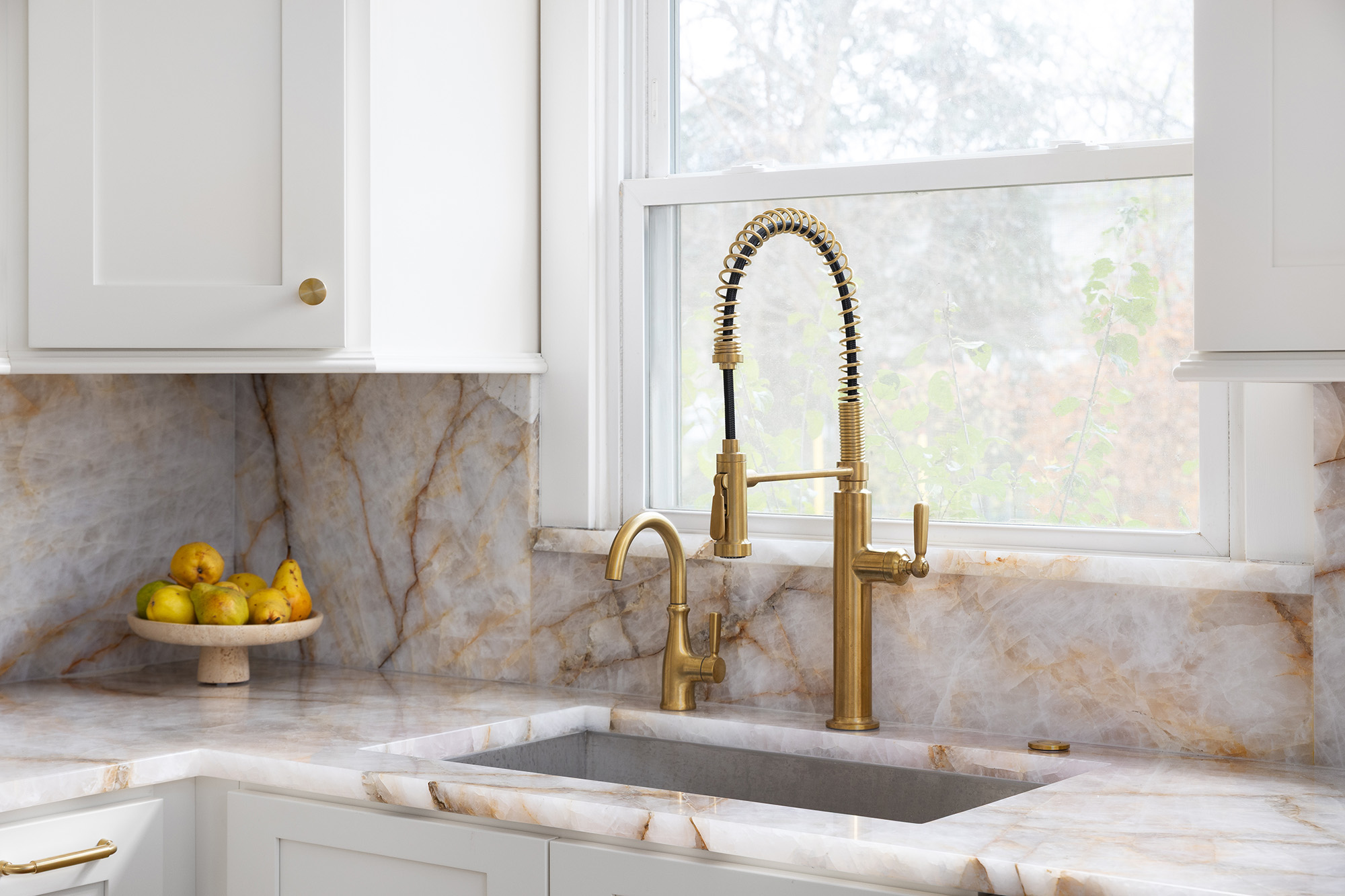
Long Island draws its drinking water from a sole source aquifer, and groundwater moving through sand and gravel picks up dissolved calcium and magnesium along the way. Hardness varies by water district and well field, so the first useful step is simply reading the annual water quality report your supplier publishes. It tells you what you are actually dealing with.
What that hardness produces in a kitchen is predictable. White or chalky film around the faucet base, cloudy rings on the counter where water sat, and a dull haze on the sink. None of it is harmful. All of it is avoidable once you understand what is happening.
A deposit is not a stain
A stain means something has soaked into the surface and discoloured it from within. A hard water mark is the opposite. Water evaporates and leaves its dissolved minerals behind as a crust sitting on top of the surface, which is why the marks look slightly raised when the light catches them and why they build up in the same spots repeatedly.
This matters because the two problems need opposite treatments. Stain removal relies on drawing something out of a porous surface. Deposit removal relies on dissolving something off it. Scrubbing harder at a mineral deposit tends to dull the finish around it long before it shifts the deposit itself.
The common internet advice can damage certain stone
Search for hard water spots and almost every result suggests white vinegar or a commercial lime remover. Those products work because they are acidic and acid dissolves mineral scale. The trouble is that the same chemistry attacks calcium carbonate, which is the main component of marble and of dolomitic stones such as Taj Mahal.
On those surfaces the acid removes the deposit and etches the stone underneath, leaving a dull patch that no amount of cleaning will polish out. If you have marble or a calcite based stone anywhere in the kitchen, acidic descalers need to stay away from it entirely. Our article on countertop etching and stains covers what to do when that has already happened.
Each surface wants a slightly different routine
Quartz is engineered and non porous, so deposits never penetrate and simply sit on the surface. Warm water, a pH neutral cleaner and a plastic scraper for stubborn build up handle it. Abrasive pads and harsh chemicals are the thing to avoid here, because they dull the resin binding the surface together rather than the stone itself.
Granite and quartzite are natural stone, sealed rather than non porous, and generally tolerant of regular cleaning. Repeated acidic contact breaks sealer down early, so the sensible approach is neutral cleaning and resealing on whatever schedule your installer recommends. Porcelain is the most chemically tolerant of the group. Every one of these materials performs well in a hard water area when its own routine is followed.
Sinks and faucet finishes show it differently
Stainless steel shows spotting most visibly because it is flat and reflective, so every evaporated droplet reads as a mark. Composite and fireclay sinks tend to show a white film instead, particularly in darker colours. The material is not failing in either case. It is simply displaying the same minerals in a different way.
Faucet finishes vary more than people expect. Polished chrome shows water spots readily. Matte black tends to display white residue most obviously of all, which surprises homeowners who chose it for a clean look. Physical vapour deposition finishes are notably hard wearing. Living finishes such as unlacquered brass are designed to change appearance over time, so mineral marking becomes part of that patina rather than a defect.
Prevention beats cleaning every time
Mineral deposits only form when standing water evaporates and leaves its minerals behind. Shorten that dwell time and the problem largely disappears. Drying the counter around the sink and wiping the faucet base after heavy use takes seconds and removes most of the work that cleaning products would otherwise have to do.
A whole house water softener is worth discussing with a plumber if hardness affects your appliances and fixtures broadly, though it is a plumbing decision rather than a countertop one and some households dislike how softened water feels. For most kitchens, a dry cloth kept near the sink and the right cleaner for your surface is genuinely enough.
See the surfaces in person before you decide
Artistic Cabinetry talks openly with homeowners about maintenance before a countertop is chosen rather than after it is installed, because knowing how a surface behaves in local conditions is part of choosing well. Quartz, granite, quartzite and porcelain all suit homes here. They simply ask for slightly different habits.
We proudly serve Smithtown, St. James, Nesconset, Stony Brook, and East Setauket, NY, and you can compare finishes side by side at Smithtown, NY. If you are weighing up countertops for a kitchen or bathroom project, contact us to book a free in home estimate and we will walk you through the realistic upkeep of each option.


