

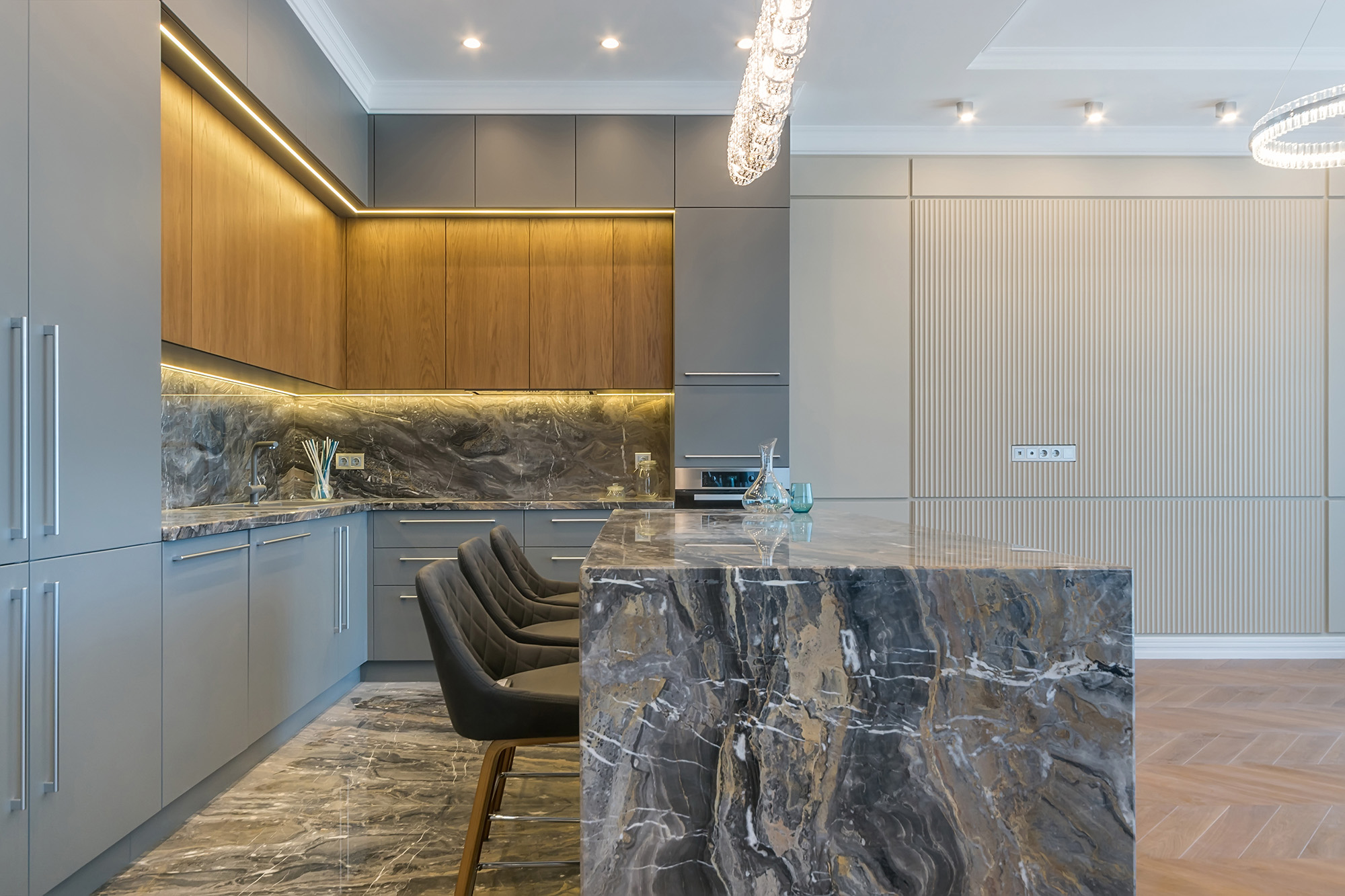
The corner is the one place in a kitchen where square footage and usable storage stop matching. On paper, a standard corner base cabinet holds more than almost anything else in the room. In practice, most people load the front third, forget what lives behind it, and work around the problem for years.
Fixing it properly starts earlier than most homeowners expect. Before looking at hardware, you need to know which kind of corner you actually have, because the two common types behave differently and the wrong mechanism in the wrong box is money spent on frustration.
True corners and blind corners are different problems
A true corner meets at ninety degrees with its own door or pair of doors set on the angle. Access runs straight in, so the challenge is depth rather than approach. A blind corner is the one that causes most of the complaints. There, one run of cabinetry dies into the side of the perpendicular run, leaving a void tucked behind the neighbouring cabinet with no door of its own.
In a blind corner you reach sideways, around a fixed panel, into space you cannot see. That is why items disappear there. Before anyone talks to you about pull outs or rotating trays, look at where the door sits in relation to the void. That single observation narrows the sensible options considerably.
The hardware only works if the clearance is right
Blind corner pull out systems swing a rear basket forward and out through the door opening in an arc. That arc needs room to travel. If the corner cabinet sits tight against its neighbour, the basket catches the adjacent door pull as it comes through, and the mechanism either binds or marks the finish within weeks.
The usual solution is a filler strip of roughly three inches between the corner cabinet and the cabinet beside it. On a plan it looks like wasted width, and it is the difference between a system that glides for a decade and one you stop using by spring. This belongs in the design conversation, not the installation day conversation.
Rotating trays and pull outs trade different things
A full round rotating tray gives excellent reach because the contents come to you. It also leaves the four corners of a square cabinet box unused, which is a genuine slice of the space. Kidney shaped and D shaped trays recover some of that area while keeping the rotation, which is why they show up in most current cabinet lines.
Pull out systems make the opposite trade. They use more of the box but travel in one direction only, so items at the back of each basket still need reaching for. Neither approach wins outright. Rotating trays suit things you grab daily. Pull outs handle weight better, which makes them a sensible home for stacked pots and small appliances.
Older homes here add one more variable
Much of the housing across Smithtown, St. James, Nesconset, Stony Brook, and East Setauket, NY dates from the nineteen fifties through the seventies, and kitchen walls in those homes are rarely perfectly square after decades of settling. Corner mechanisms are the least forgiving hardware in a kitchen precisely because they depend on consistent clearance through a full range of movement.
A corner that sits a quarter inch out of square will carry a fixed shelf without complaint and bind a pull out on the third use. Measuring the real corner angle before ordering, rather than assuming ninety degrees, prevents the most common installation surprise we see in older local kitchens.
Sometimes the smartest move is to spend the corner differently
Not every corner needs a mechanism. Placing the sink or the cooktop on the diagonal puts the hardest cabinet in the room to work on a function that never needed deep storage behind it, and frees your easiest cabinets for the things you reach for every day. It is a planning decision rather than a hardware purchase, and it suits some layouts beautifully.
If the corner stays as storage and the budget is finite, assign it honestly. Seasonal serving pieces, the stand mixer and bulk backups live there very happily. Daily items do not. A corner holding the right contents stops feeling like a problem at all, with or without moving parts.
Come and work through your corner with us
Artistic Cabinetry has been helping homeowners solve layout problems like this for years, and corners are a conversation we have most weeks. Our in house designers will look at your actual measurements, the state of your walls and how you use the kitchen before recommending anything, because the honest answer sometimes costs less than the hardware catalogue suggests.
You can see corner mechanisms working in person at Smithtown, NY, and we proudly serve Smithtown, St. James, Nesconset, Stony Brook, and East Setauket, NY. If you are planning new cabinets or trying to get more from the ones you have, contact us to arrange a free in home estimate.


